
Chapter 12: Diseases of the Skin and Subcutaneous Tissue(L00-L99)

ICD 10 CM
Chapter 1: Certain Infectious and Parasitic Diseases (A00-B99), U07.1, U09.9
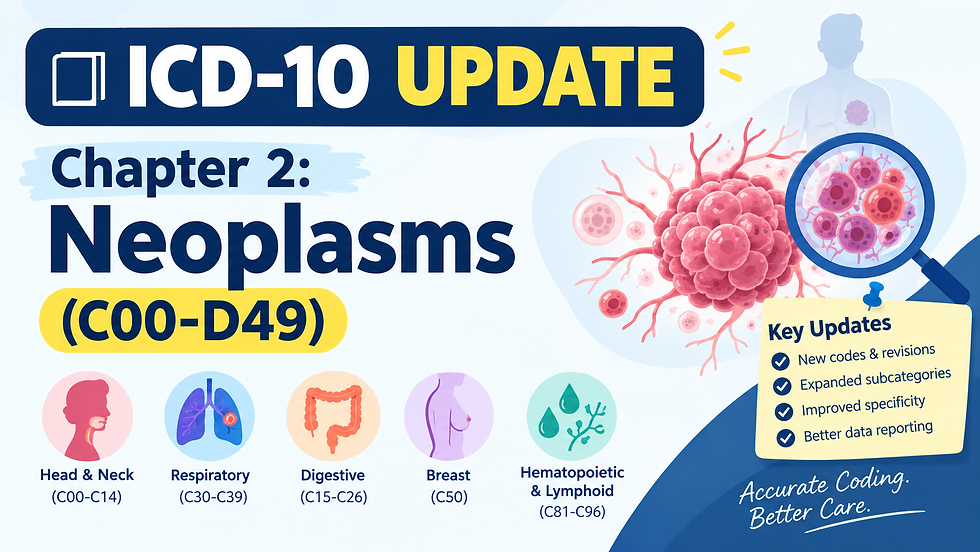
Chapter 2: Neoplasms (C00-D49)
Chapter 3: Diseases of the blood and blood-forming organs and certain disorders involving the immune mechanism (D50-D89)
Reserved for future guideline expansion
Chapter 4: Endocrine, Nutritional, and Metabolic Diseases (E00-E89)
Chapter 5: Mental, Behavioral and Neurodevelopmental disorders (F01 – F99)
Chapter 6: Diseases of the Nervous System (G00-G99)
Chapter 7: Diseases of the Eye and Adnexa (H00-H59)
Chapter 8: Diseases of the Ear and Mastoid Process (H60-H95)
Chapter 9: Diseases of the Circulatory System (I00-I99)
Chapter 10: Diseases of the Respiratory System (J00-J99), U07.0
Chapter 11: Diseases of the Digestive System (K00-K95)
Chapter 12: Diseases of the Skin and Subcutaneous Tissue (L00-L99)
Chapter 13: Diseases of the Musculoskeletal System and Connective Tissue (M00-M99)
Chapter 14: Diseases of Genitourinary System (N00-N99)
Chapter 15: Pregnancy, Childbirth, and the Puerperium (O00-O9A)
Chapter 16: Certain Conditions Originating in the Perinatal Period (P00-P96)
Chapter 17: Congenital malformations, deformations, and chromosomal abnormalities (Q00-QA1)
Chapter 18: Symptoms, signs, and abnormal clinical and laboratory findings, not elsewhere classified (R00-R99)
Chapter 19: Injury, poisoning, and certain other consequences of external causes (S00-T88
Chapter 20: External Causes of Morbidity (V00-Y99)
Chapter 21: Factors influencing health status and contact with health services (Z00-Z99)
Chapter 22: Codes for Special Purposes (U00-U85)

Chapter 12: Diseases of the Skin and Subcutaneous Tissue (L00-L99)
Medycoding Notes
What is Ulcer ?
An ulcer is an open sore or break in the skin or mucous membrane that occurs when tissue is damaged and fails to heal normally.
Type of Skin Ulcer
1. Pressure Ulcer
Also called a bed sore or decubitus ulcer.
Caused by prolonged pressure on an area of the body, usually over a bony prominence.
Common locations:
Sacrum
Heel
Hip
Elbow
Back of the head
2. Non-Pressure Ulcer
A non-pressure ulcer is an open sore or break in the skin that is NOT caused by prolonged pressure.
The ulcer may develop because of conditions such as poor blood circulation, diabetes, venous disease, infection, trauma, or other underlying problems.
a. Pressure ulcer stage codes
1) Pressure ulcer stages
Codes in category L89, Pressure ulcer, identify the site and stage of the pressure ulcer.
The ICD-10-CM classifies pressure ulcer stages based on severity, which is designated by stages 1-4, deep tissue pressure injury, unspecified stage, and unstageable.
Assign as many codes from category L89 as needed to identify all the pressure ulcers the patient has, if applicable.
See Section I.B.14. for pressure ulcer stage documentation by clinicians other than patient's provider.
Medycoding Notes
L89.000 - Pressure ulcer of unspecified elbow, unstageable
L89.001 - Pressure ulcer of unspecified elbow, stage 1
L89.002 - Pressure ulcer of unspecified elbow, stage 2
L89.003 - Pressure ulcer of unspecified elbow, stage 3
L89.004 - Pressure ulcer of unspecified elbow, stage 4
L89.006 - Pressure-induced deep tissue damage of unspecified elbow
L89.009 - Pressure ulcer of unspecified elbow, unspecified stage
Stage 1- pre-ulcer skin changes
Stage 2- ulcer with abrasion, blister, partial thickness skin loss involving epidermis and/or dermis
Stage 3- ulcer with full thickness skin loss involving damage or necrosis of subcutaneous tissue
Stage 4- ulcer with necrosis of soft tissues through to underlying muscle, tendon, or bone
What does “assign as many codes as needed” mean?
If a patient has multiple pressure ulcers at different sites, don't choose just one L89 code. Code each documented pressure ulcer separately.
Example
A patient has:
Stage 3 pressure ulcer of right heel
Stage 2 pressure ulcer of left buttock
Stage 4 pressure ulcer of sacral region
You would assign three L89 codes, one for each ulcer.
2) Unstageable pressure ulcers
Assignment of the code for unstageable pressure ulcer (L89.--0) should be based on the clinical documentation.
These codes are used for ICD-10-CM Official Guidelines for Coding and pressure ulcers whose stage cannot be clinically determined (e.g., the ulcer is covered by eschar or has been treated with a skin or muscle graft).
This code should not be confused with the codes for unspecified stage (L89.--9). When there is no documentation regarding the stage of the pressure ulcer, assign the appropriate code for unspecified stage (L89.-- 9).
If during an encounter, the stage of an unstageable pressure ulcer is revealed after debridement, assign only the code for the stage revealed following debridement.
Medycoding Notes
Practice Scenario
A patient is admitted with a pressure ulcer of the sacral region. Before debridement, the physician documents:
“Patient has a sacral pressure ulcer completely covered with thick necrotic eschar. The depth and stage of the ulcer cannot be determined due to the overlying eschar. The ulcer is therefore unstageable.”
The physician performs surgical debridement and removes the necrotic tissue. After the eschar is completely removed, the physician documents:
“Following debridement, the ulcer extends through the full thickness of the skin into the subcutaneous tissue. Adipose (fat) tissue is visible. There is no exposed fascia, muscle, tendon, cartilage, or bone. The pressure ulcer is classified as Stage 3.”
3) Documented pressure ulcer stage
Assignment of the pressure ulcer stage code should be guided by clinical documentation of the stage or documentation of the terms found in the Alphabetic Index.
For clinical terms describing the stage that are not found in the Alphabetic Index, and there is no documentation of the stage, the provider should be queried.
Medycoding Notes
For example:
“During debridement, the sacral pressure ulcer was found to extend to exposed bone. Stage not documented.”
You should not automatically code Stage 4 just because bone is exposed, unless the documented terminology supports the stage under the Alphabetic Index. So,query the provider in this case.
4) Patients admitted with pressure ulcers documented as healed
No code is assigned if the documentation states that the pressure ulcer is completely healed at the time of admission.
5) Pressure ulcers documented as healing
Pressure ulcers described as healing should be assigned the appropriate pressure ulcer stage code based on the documentation in the medical record.
If the documentation does not provide information about the stage of the healing pressure ulcer, assign the appropriate code for unspecified stage.
If the documentation is unclear as to whether the patient has a current (new) pressure ulcer or if the patient is being treated for a healing pressure ulcer, query the provider.
For ulcers that were present on admission but healed at the time of discharge, assign the code for the site and stage of the pressure ulcer at the time of admission.
6) Patient admitted with pressure ulcer evolving into another stage during the admission
If a patient is admitted to an inpatient hospital with a pressure ulcer at one stage and it progresses to a higher stage, two separate codes should be assigned: one code for the site and stage of the ulcer on admission and a second code for the same ulcer site and the highest stage reported during the stay.
7) Pressure-induced deep tissue damage
For pressure-induced deep tissue damage or deep tissue pressure injury, assign only the appropriate code for pressure-induced deep tissue damage (L89.--6).
Medycoding Notes
Key point: When the provider specifically documents deep tissue pressure injury/damage, you don't try to convert it into a conventional pressure-ulcer stage based on depth or appearance. You use the “6” deep-tissue-damage code for the documented site.
b. Non-Pressure Chronic Ulcers
1) Patients admitted with non-pressure ulcers documented as healed
No code is assigned if the documentation states that the non-pressure ulcer is completely healed at the time of admission.
2) Non-pressure ulcers documented as healing
Non-pressure ulcers described as healing should be assigned the appropriate non-pressure ulcer code based on the documentation in the medical record. If the documentation does not provide information about the severity of the healing non-pressure ulcer, assign the appropriate code for unspecified severity.
If the documentation is unclear as to whether the patient has a current (new) non-pressure ulcer or if the patient is being treated for a healing non-pressure ulcer, query the provider.
For ulcers that were present on admission but healed at the time of discharge, assign the code for the site and severity of the non-pressure ulcer at the time of admission.
3) Patient admitted with non-pressure ulcer that progresses to another severity level during the admission
If a patient is admitted to an inpatient hospital with a non-pressure ulcer at one severity level and it progresses to a higher severity level, two separate codes should be assigned: one code for the site and severity level of the ulcer on admission and a second code for the same ulcer site and the highest severity level reported during the stay.
See Section I.B.14. for pressure ulcer stage documentation by clinicians other than patient's provider.
Comments