
ICD-10 CM Question Interview Fresher Chapter 2

ICD 10 CM
Chapter 1: Certain Infectious and Parasitic Diseases (A00-B99), U07.1, U09.9
Chapter 2: Neoplasms (C00-D49)
Chapter 3: Diseases of the blood and blood-forming organs and certain disorders involving the immune mechanism (D50-D89)
Reserved for future guideline expansion
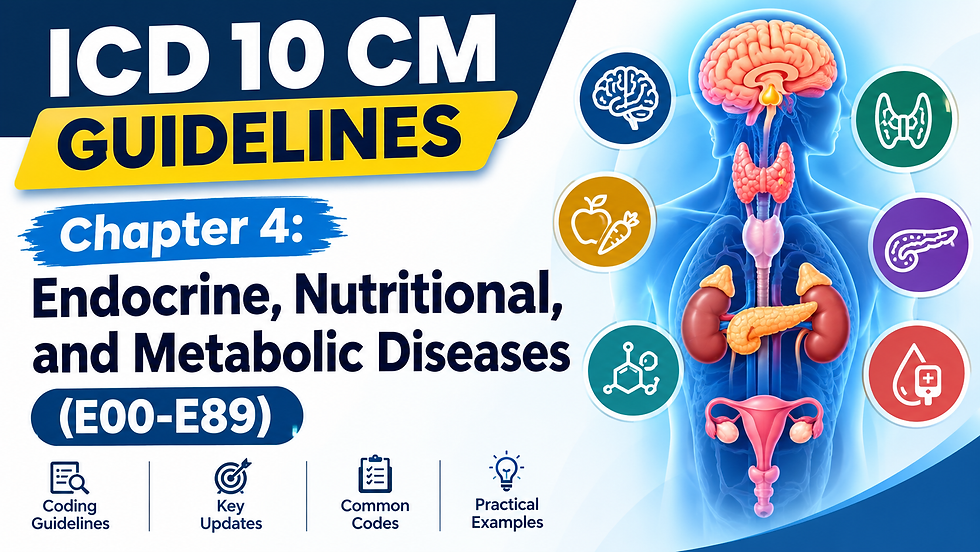
Chapter 4: Endocrine, Nutritional, and Metabolic Diseases (E00-E89)
Chapter 5: Mental, Behavioral and Neurodevelopmental disorders (F01 – F99)
Chapter 6: Diseases of the Nervous System (G00-G99)
Chapter 7: Diseases of the Eye and Adnexa (H00-H59)
Chapter 8: Diseases of the Ear and Mastoid Process (H60-H95)
Chapter 9: Diseases of the Circulatory System (I00-I99)
Chapter 10: Diseases of the Respiratory System (J00-J99), U07.0
Chapter 11: Diseases of the Digestive System (K00-K95)
Chapter 12: Diseases of the Skin and Subcutaneous Tissue (L00-L99)
Chapter 13: Diseases of the Musculoskeletal System and Connective Tissue (M00-M99)
Chapter 14: Diseases of Genitourinary System (N00-N99)
Chapter 15: Pregnancy, Childbirth, and the Puerperium (O00-O9A)
Chapter 16: Certain Conditions Originating in the Perinatal Period (P00-P96)
Chapter 17: Congenital malformations, deformations, and chromosomal abnormalities (Q00-QA1)
Chapter 18: Symptoms, signs, and abnormal clinical and laboratory findings, not elsewhere classified (R00-R99)
Chapter 19: Injury, poisoning, and certain other consequences of external causes (S00-T88
Chapter 20: External Causes of Morbidity (V00-Y99)
Chapter 21: Factors influencing health status and contact with health services (Z00-Z99)
Chapter 22: Codes for Special Purposes (U00-U85)
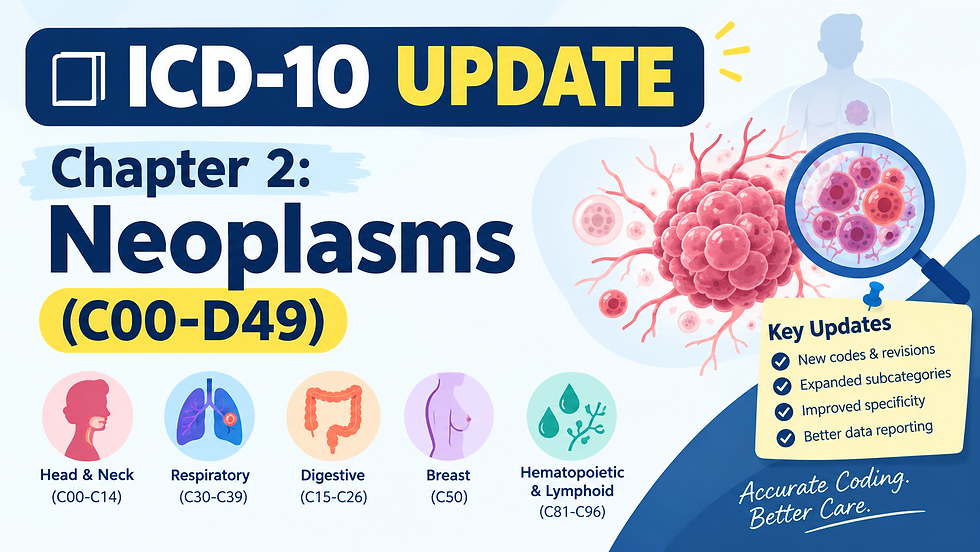
Chapter 2: Neoplasms (C00-D49)
Medycoding Notes
What is Neoplasm ?
A neoplasm measn new growth.
A neoplasm is an abnormal mass of tissue that develops because of uncontrolled and abnormal cell growth. The growth occurs independently of the normal regulatory mechanisms that control surrounding tissues.
Unlike reversible changes, such as hyperplasia or hypertrophy, a neoplasm continues to grow even after the initial stimulus or triggering factor has been removed.
General Guidelines Chapter 2 of the ICD-10-CM contains the codes for most benign and all malignant neoplasms. Certain benign neoplasms, such as prostatic adenomas, may be found in the specific body system chapters.
To properly code a neoplasm, it is necessary to determine from the record if the neoplasm is benign, in-situ, malignant, or of uncertain histologic behavior. If malignant, any secondary (metastatic) sites should also be determined.
Practice Question
If the physican documeted as primary maligant of larynx and Malignant melanoma of the skin of right hand, which one will be primary ?
Code both as primary as the metastatic is not given.
Medycoding Notes
If Secondary sites is not given consider it as primary.
Medycoding Notes
Behavior of neoplasm
1.Benign
2.Malignant
3.In-situ
4.Uncertain behaviour
5.Unspecified
1. Benign neoplasm
A benign neoplasm is a tumor that does not invade surrounding tissues or spread (metastasize) to distant parts of the body.
Usually grows slowly.
Often has well-defined borders.
Does not metastasize.
However, it can still cause problems if it presses on nearby organs or structures.
Example:A benign lipoma is a tumor made of fat cells that generally remains localized.
Easy memory:👉 Benign = stays in one place
2. Malignant neoplasm
A malignant neoplasm is a cancerous tumor that can invade surrounding tissues and potentially spread to other parts of the body (metastasis).
May grow rapidly.
Can invade nearby tissues.
Can spread through the blood or lymphatic system.
Can damage normal organs and become life-threatening.
Example:Lung cancer can invade nearby structures and metastasize to the liver, brain, bones, etc.
Easy memory:👉 Malignant = invades + can spread
3. In-situ neoplasm
In situ means “in its original place.”
An in-situ neoplasm consists of abnormal cells that are confined to the layer of tissue where they originated and have not invaded through the basement membrane into deeper tissues.
It is often considered an early/pre-invasive stage of cancer.
Example:Carcinoma in situ of the cervix means abnormal cancerous-appearing cells are present, but they have not invaded deeper cervical tissue.
Easy memory:👉 In situ = abnormal cells are still in their original layer
Important: In-situ does not mean benign. The cells can be malignant in appearance, but they have not yet invaded.
4. Neoplasm of uncertain behavior
A neoplasm of uncertain behavior is one where the available pathology/information cannot determine whether the tumor is benign or malignant.
The key issue is uncertainty about the biological behavior of the tumor.
For example, the tumor may have unusual or borderline characteristics, and the pathologist cannot definitively classify it as benign or malignant.
Easy memory:👉 Uncertain behavior = “We cannot determine benign vs malignant.”
5. Neoplasm of unspecified behavior
Unspecified behavior means the behavior of the neoplasm has not been documented or specified.
This is different from uncertain behavior.
Uncertain behavior: The tumor has been evaluated, but its behavior cannot be determined.
Unspecified behavior: The documentation does not tell us the behavior.
Primary malignant neoplasms overlapping site boundaries
A primary malignant neoplasm that overlaps two or more contiguous (next to each other) sites should be classified to the subcategory/code .8 ('overlapping lesion'), unless the combination is specifically indexed elsewhere. For multiple neoplasms of the same site that are not contiguous such as tumors in different quadrants of the same breast, codes for each site should be assigned.
Medycoding Notes
When the neoplasm involves overlapping sites and there is no specific combination code, ICD-10-CM generally uses the .8 subcategory for overlapping sites.
Example:
Suppose a malignant neoplasm involves multiple contiguous parts of the colon and the site of origin cannot be determined.
You would look for:
C18.8 – Malignant neoplasm of overlapping sites of colon
Practice Question
How to code if there is cancer of splenic flexure colon and tranverse colon ?
Answer - Dont code seperately since these are the overlappign sites.
Malignant neoplasm of ectopic tissue
Malignant neoplasms of ectopic tissue are to be coded to the site of origin mentioned, e.g., ectopic pancreatic malignant neoplasms involving the stomach are coded to malignant neoplasm of pancreas, unspecified (C25.9).
Medycoding Notes
Ectopic tissue means tissue that is normally found in one organ but is located in an abnormal or unusual location.
When a malignant neoplasm develops in ectopic tissue, ICD-10-CM instructs us to code it to the site of origin of that ectopic tissue, rather than the anatomical location where the ectopic tissue happens to be found.
Practice Question
A patient is diagnosed with a malignant neoplasm arising from ectopic thyroid tissue located at the base of the tongue. The physician confirms that the tumor originated from the ectopic thyroid tissue.
Which ICD-10-CM code should be assigned?
A. C01 – Malignant neoplasm of base of tongue
B. C73 – Malignant neoplasm of thyroid gland
C. C79.89 – Secondary malignant neoplasm of other sites
D. C80.1 – Malignant (primary) neoplasm, unspecified
How to lead Code
The neoplasm table in the Alphabetic Index should be referenced first.
However, if the histological term is documented, that term should be referenced first, rather than going immediately to the Neoplasm Table, in order to determine which column in the Neoplasm Table is appropriate.
For example, if the documentation indicates “adenoma,” refer to the term in the Alphabetic Index to review the entries under this term and the instructional note to “see also neoplasm, by site, benign.” The table provides the proper code based on the type of neoplasm and the site. It is important to select the proper column in the table that corresponds to the type of neoplasm. The Tabular List should then be referenced to verify that the correct code has been selected from the table and that a more specific site code does not exist.
Practice Question
Check ICD :
Fibroadenoma of the right breast
Adenocarcinoma of the prostate
Adenofibroma of the stomach
Answer -
Medycoding Notes
Code primary malignant neoplasm category from C00 to C075.
a. Admission/Encounter for treatment of primary site
If the malignancy is chiefly responsible for occasioning the patient admission/encounter and treatment is directed at the primary site, designate the primary malignancy as the principal/first-listed diagnosis. The only exception to this guideline is if the administration of chemotherapy, immunotherapy or external beam radiation therapy is chiefly responsible for occasioning the admission/encounter. In that case, assign the appropriate Z51.-- code as the first-listed or principal diagnosis, and the underlying diagnosis or problem for which the service is being performed as a secondary diagnosis.
b. Admission/Encounter for treatment of secondary site
When a patient is admitted because of a primary neoplasm with metastasis and treatment is directed toward the secondary site only, the secondary neoplasm is designated as the principal diagnosis even though the primary malignancy is still present.
c. Coding and sequencing of complications
Coding and sequencing of complications associated with the malignancies or with the therapy thereof are subject to the following guidelines:
1) Anemia associated with malignancy
When admission/encounter is for management of an anemia associated with the malignancy, and the treatment is only for anemia, the appropriate code for the malignancy is sequenced as the principal or first-listed diagnosis followed by the appropriate code for the anemia (such as code D63.0, Anemia in neoplastic disease).
2) Anemia associated with chemotherapy, immunotherapy and radiation therapy
When the admission/encounter is for management of an anemia associated with an adverse effect of the administration of chemotherapy or immunotherapy and the only treatment is for the anemia, the anemia code is sequenced first followed by the appropriate codes for the neoplasm and the adverse effect (T45.1X5-, Adverse effect of antineoplastic and immunosuppressive drugs). When the admission/encounter is for management of an anemia associated with an adverse effect of radiotherapy, the anemia code should be sequenced first, followed by the appropriate neoplasm code and code Y84.2, Radiological procedure and radiotherapy as the cause of abnormal reaction of the patient, or of later complication, without mention of misadventure at the time of the procedure.
3) Management of dehydration due to the malignancy
When the admission/encounter is for management of dehydration due to the malignancy and only the dehydration is being treated (intravenous rehydration), the dehydration is sequenced first, followed by the code(s) for the malignancy.
4) Treatment of a complication resulting from a surgical procedure
When the admission/encounter is for treatment of a complication resulting from a surgical procedure, designate the complication as the principal or first-listed diagnosis if treatment is directed at resolving the complication.
d. Primary malignancy previously excised
When a primary malignancy has been previously excised or eradicated from its site and there is no further treatment directed to that site and there is no evidence of any existing primary malignancy at that site, a code from category Z85,Personal history of malignant neoplasm, should be used to indicate the former site of the malignancy. Any mention of extension, invasion, or metastasis to another site is coded as a secondary malignant neoplasm to that site. The secondary site may be the principal or first-listed diagnosis with the Z85 code used as a secondary code.
e. Admissions/Encounters involving antineoplastic chemotherapy, immunotherapy and radiation therapy
1) Episode of care involves surgical removal of neoplasm
When an episode of care involves the surgical removal of a neoplasm, primary or secondary site, followed by adjunct chemotherapy or radiation treatment during the same episode of care, the code for the neoplasm should be assigned as principal or first-listed diagnosis.
2) Patient admission/encounter chiefly for administration of antineoplastic chemotherapy, immunotherapy and radiation therapy
If a patient admission/encounter is chiefly for the administration of chemotherapy, immunotherapy or external beam radiation therapy for the treatment of a neoplasm, assign code Z51.0, Encounter for antineoplastic radiation therapy, or Z51.11, Encounter for antineoplastic chemotherapy, or Z51.12, Encounter for antineoplastic immunotherapy as the first-listed or principal diagnosis. If the reason for the encounter is more than one type of antineoplastic therapy, code Z51.0 and codes from subcategory Z51.1 may be assigned together, in which case one of these codes would be reported as a secondary diagnosis. The malignancy for which the therapy is being administered should be assigned as a secondary diagnosis. If a patient admission/encounter is for the insertion or implantation of radioactive elements (e.g., brachytherapy) the appropriate code for the malignancy is sequenced as the principal or first-listed diagnosis. Code Z51.0 should not be assigned. 3) Patient admitted for radiation therapy, chemotherapy or immunotherapy and develops complications When a patient is admitted for the purpose of external beam radiotherapy, immunotherapy or chemotherapy and develops complications such as uncontrolled nausea and vomiting or dehydration, the principal or first-listed diagnosis is Z51.0, Encounter for antineoplastic radiation therapy, or Z51.11, Encounter for antineoplastic chemotherapy, or Z51.12, Encounter for antineoplastic immunotherapy followed by any codes for the complications.
When a patient is admitted for the purpose of insertion or implantation of radioactive elements (e.g., brachytherapy) and develops complications such as uncontrolled nausea and vomiting or dehydration, the principal or first-listed diagnosis is the appropriate code for the malignancy followed by any codes for the complications.
f. Admission/encounter to determine extent of malignancy
When the reason for admission/encounter is to determine the extent of the malignancy, or for a procedure such as paracentesis or thoracentesis, the primary malignancy or appropriate metastatic site is designated as the principal or first-listed diagnosis, even though chemotherapy or radiotherapy is administered.
g. Symptoms, signs, and abnormal findings listed in Chapter 18 associated with neoplasms
Symptoms, signs, and ill-defined conditions listed in Chapter 18 characteristic of, or associated with, an existing primary or secondary site malignancy cannot be used to replace the malignancy as principal or first-listed diagnosis, regardless of the number of admissions or encounters for treatment and care of the neoplasm. See section I.C.21. Factors influencing health status and contact with health services, Encounter for prophylactic organ removal.
h. Admission/encounter for pain control/management
See Section I.C.6. for information on coding admission/encounter for pain control/management.
i. Malignancy in two or more noncontiguous sites
A patient may have more than one malignant tumor in the same organ. These tumors may represent different primaries or metastatic disease, depending on the site. Should the documentation be unclear, the provider should be queried as to the status of each tumor so that the correct codes can be assigned.
j. Disseminated malignant neoplasm, unspecified
Code C80.0, Disseminated malignant neoplasm, unspecified, is for use only in those cases where the patient has advanced metastatic disease and no known primary or secondary sites are specified. It should not be used in place of assigning codes for the primary site and all known secondary sites.
k. Malignant neoplasm without specification of site
Code C80.1, Malignant (primary) neoplasm, unspecified, equates to Cancer, unspecified. This code should only be used when no determination can be made as to the primary site of a malignancy. This code should rarely be used in the inpatient setting.
l. Sequencing of neoplasm codes
1) Encounter for treatment of primary malignancy
If the reason for the encounter is for treatment of a primary malignancy, assign the malignancy as the principal/first-listed diagnosis. The primary site is to be sequenced first, followed by any metastatic sites.
2) Encounter for treatment of secondary malignancy
When an encounter is for a primary malignancy with metastasis and treatment is directed toward the metastatic (secondary) site(s) only, the metastatic site(s) is designated as the principal/first-listed diagnosis. The primary malignancy is coded as an additional code.
3) Malignant neoplasm in a pregnant patient
When a pregnant patient has a malignant neoplasm, a code from subcategory O9A.1-, Malignant neoplasm complicating pregnancy, childbirth, and the puerperium, should be sequenced first, followed by the appropriate code from Chapter 2 to indicate the type of neoplasm.
4) Encounter for complication associated with a neoplasm
When an encounter is for management of a complication associated with a neoplasm, such as dehydration, and the treatment is only for the complication, the complication is coded first, followed by the appropriate code(s) for the neoplasm. The exception to this guideline is anemia. When the admission/encounter is for management of an anemia associated with the malignancy, and the treatment is only for anemia, the appropriate code for the malignancy is sequenced as the principal or first-listed diagnosis followed by code D63.0, Anemia in neoplastic disease.
5) Complication from surgical procedure for treatment of a neoplasm
When an encounter is for treatment of a complication resulting from a surgical procedure performed for the treatment of the neoplasm, designate the complication as the principal/first-listed diagnosis. See the guideline regarding the coding of a current malignancy versus personal history to determine if the code for the neoplasm should also be assigned.
6) Pathologic fracture due to a neoplasm
When an encounter is for a pathological fracture due to a neoplasm, and the focus of treatment is the fracture, a code from subcategory M84.5, Pathological fracture in neoplastic disease, should be sequenced first, followed by the code for the neoplasm. If the focus of treatment is the neoplasm with an associated pathological fracture, the neoplasm code should be sequenced first, followed by a code from M84.5 for the pathological fracture.
m. Current malignancy versus personal history of malignancy
When a primary malignancy has been excised but further treatment, such as an additional surgery for the malignancy, radiation therapy or chemotherapy is directed to that site, the primary malignancy code should be used until treatment is completed.
When a primary malignancy has been previously excised or eradicated from its site, there is no further treatment (of the malignancy) directed to that site, and there is no evidence of any existing primary malignancy at that site, a code from category Z85, Personal history of malignant neoplasm, should be used to indicate the former site of the malignancy.
Notes : Codes from subcategories Z85.0 – Z85.85 should only be assigned for the former site of a primary malignancy, not the site of a secondary malignancy.
Code Z85.89 may be assigned for the former site(s) of either a primary or secondary malignancy.
See Section I.C.21. Factors influencing health status and contact with health services, History (of)
n. Leukemia, Multiple Myeloma, and Malignant Plasma Cell Neoplasms in remission versus personal history
The categories for leukemia, and category C90, Multiple myeloma and malignant plasma cell neoplasms, have codes indicating whether or not the leukemia has achieved remission. There are also codes Z85.6, Personal history of leukemia, and Z85.79, Personal history of other malignant neoplasms of lymphoid, hematopoietic and related tissues. If the documentation is unclear as to whether the leukemia has achieved remission, the provider should be queried. See Section I.C.21. Factors influencing health status and contact with health services, History (of)
o. Aftercare following surgery for neoplasm See Section I.C.
21. Factors influencing health status and contact with health services, Aftercare
p. Follow-up care for completed treatment of a malignancy See Section I.C.
21. Factors influencing health status and contact with health services, Follow-up
q. Prophylactic organ removal for prevention of malignancy
See Section I.C. 21, Factors influencing health status and contact with health services, Prophylactic organ removal
r. Malignant neoplasm associated with transplanted organ
A malignant neoplasm of a transplanted organ should be coded as a transplant complication. Assign first the appropriate code from category T86.-,Complications of transplanted organs and tissue, followed by code C80.2, Malignant neoplasm associated with transplanted organ. Use an additional code for the specific malignancy.
s. Breast Implant Associated Anaplastic Large Cell Lymphoma
Breast implant associated anaplastic large cell lymphoma (BIA-ALCL) is a type of lymphoma that can develop around breast implants. Assign code C84.7A, Anaplastic large cell lymphoma, ALK-negative, breast, for BIA-ALCL or C84.7B, Anaplastic large cell lymphoma, ALK-negative, in remission, for BIAALCL in remission. Do not assign a complication code from chapter 19.
t. Secondary malignant neoplasm of lymphoid tissue
When a malignant neoplasm of lymphoid tissue metastasizes beyond the lymph nodes, a code from categories C81-C85 with a final character identifying “extranodal and solid organ sites” should be assigned rather than a code for the secondary neoplasm of the affected solid organ. For example, for metastasis of diffuse large B-cell lymphoma to the lung, brain and left adrenal gland, assign code C83.398, Diffuse large B-cell lymphoma of other extranodal and solid organ sites.


Comments