
Anatomy for Medical Coder- Endocrine Gland

Endocrine Gland System for CPC Fresher
Endocrine System
Endocrine glands are ductless glands, meaning they do not have ducts to carry their secretions. Instead, they release hormones directly into the bloodstream, which transports them to target organs where they regulate various body functions.
The endocrine system is made up of endocrine glands and hormone-producing cells located throughout the body.
Major endocrine glands:
Hypothalamus
Pituitary (Master gland)
Pineal
Thyroid
Parathyroid
Thymus
Adrenal
Pancreas
Testes
Ovaries
In addition to these glands, several organs such as the gastrointestinal (GI) tract, liver, kidneys, and heart also produce hormones that help regulate various physiological processes.
Hypothalamus Gland
The hypothalamus is a small but important part of the forebrain (diencephalon) located just above the pituitary gland. It acts as the control center of the endocrine system by producing hormones that regulate the pituitary gland, often called the master gland.
The hypothalamus contains specialized neurosecretory cells (nuclei) that produce two types of hormones:
Releasing hormones(Gonadotropin-Releasing Hormone -GnRH) – Stimulate the pituitary gland to release hormones.
Inhibiting hormones (Somatostatin) – Suppress the release of pituitary hormones.

The Pituitary Gland
The pituitary gland is known as the "Master Gland" because it controls the activity of many other endocrine glands. It is located in a bony cavity called the Sella Turcica of the sphenoid bone and is connected to the hypothalamus by a stalk called the infundibulum.
The pituitary gland has two main parts:
Anterior Pituitary (Adenohypophysis) – Produces and secretes hormones.
Posterior Pituitary (Neurohypophysis) – Stores and releases hormones produced by the hypothalamus.
The posterior pituitary does not produce hormones; instead, it stores and releases Oxytocin and Antidiuretic Hormone (ADH or Vasopressin), which are synthesized in the hypothalamus. Oxytocin stimulates uterine contractions during labor and milk ejection during breastfeeding. ADH (Vasopressin) acts on the kidneys to increase water reabsorption, reducing urine output and helping maintain the body's fluid balance.
Pineal Gland
The pineal gland is located on the dorsal side of forebrain.
Pineal secretes a hormone called melatonin. Melatonin plays a very important role in the regulation of a 24-hour (diurnal) rhythm of our body.
For example, it helps in maintaining the normal rhythms of sleep-wake cycle, body temperature. In addition, melatonin also influences metabolism, pigmentation, the menstrual cycle as well as our defense capability.
Thyroid Gland

The thyroid gland is a butterfly-shaped endocrine gland located in the front of the neck, on either side of the trachea (windpipe). It has two lobes (right and left) connected by a thin bridge of tissue called the isthmus. The gland is made up of numerous thyroid follicles, which contain follicular cells responsible for producing the thyroid hormones Triiodothyronine (T3) and Thyroxine (T4). Iodine is an essential mineral required for the synthesis of these hormones.
A deficiency of iodine can lead to hypothyroidism, a condition in which the thyroid gland produces insufficient hormones. This often causes goiter, an enlargement of the thyroid gland.
Excess production of thyroid hormones causes hyperthyroidism, which increases the body's metabolic rate. A common form is Graves' disease (Exophthalmic Goiter), characterized by enlargement of the thyroid gland, protruding eyes (exophthalmos), weight loss despite increased appetite, heat intolerance, rapid heartbeat (tachycardia), nervousness, and increased basal metabolic rate.
Parathyroid Gland

The parathyroid glands are four small endocrine glands located on the posterior (back) surface of the thyroid gland, with two glands on each thyroid lobe. They secrete Parathyroid Hormone (PTH), and its secretion is regulated by the calcium level in the blood. When blood calcium levels decrease, the parathyroid glands release more PTH.
Thymus Gland
The thymus gland is a lobulated endocrine and lymphoid organ located in the upper chest (mediastinum), behind the sternum (breastbone) and in front of the heart and great vessels. It is most active during childhood and plays a vital role in the development and maturation of the immune system.
The thymus secretes thymosin, a hormone that helps T-lymphocytes (T-cells) mature and strengthens the body's immune system. As people age, the thymus shrinks and produces less thymosin, causing the immune system to weaken and increasing the risk of infections.
Adrenal Gland

The adrenal glands are two small endocrine glands, with one located on top of each kidney. Each adrenal gland has two parts:
Adrenal Cortex (Outer layer) – Produces steroid hormones.
Adrenal Medulla (Inner layer) – Produces catecholamines.
The adrenal medulla secretes Adrenaline (Epinephrine) and Noradrenaline (Norepinephrine), also called catecholamines. These are known as "Fight or Flight" or emergency hormones because they are released during stress or emergencies. They increase heart rate, blood pressure, breathing rate, blood glucose, sweating, and pupil dilation, preparing the body to respond quickly.
A deficiency of adrenal cortex hormones causes Addison's Disease, characterized by fatigue, weakness, weight loss, low blood pressure, and electrolyte imbalance.
Pancreas Gland
The pancreas is a mixed (composite) gland because it functions as both an exocrine gland (produces digestive enzymes) and an endocrine gland (produces hormones). The endocrine part contains clusters of cells called the Islets of Langerhans, which consist mainly of alpha (α) cells and beta (β) cells.
Alpha (α) cells secrete glucagon, which raises blood glucose levels by stimulating glycogen breakdown (glycogenolysis) and glucose production (gluconeogenesis) in the liver. Therefore, glucagon is called a hyperglycemic hormone.
Beta (β) cells secrete insulin, which lowers blood glucose levels by increasing glucose uptake into cells and converting glucose into glycogen (glycogenesis). Therefore, insulin is called a hypoglycemic hormone.

Insulin and glucagon work together to maintain normal blood glucose (glucose homeostasis). A deficiency of insulin or ineffective insulin action causes Diabetes Mellitus, characterized by high blood glucose (hyperglycemia), glucose in urine (glycosuria), and ketone body formation (ketosis). Many diabetic patients require insulin therapy.
Testes
The testes are a pair of male reproductive organs located in the scrotum (outside the abdominal cavity). They have two functions: produce sperm (reproductive function) and secrete hormones (endocrine function). The Leydig (interstitial) cells present between the seminiferous tubules produce the male sex hormone testosterone, which is the main androgen.
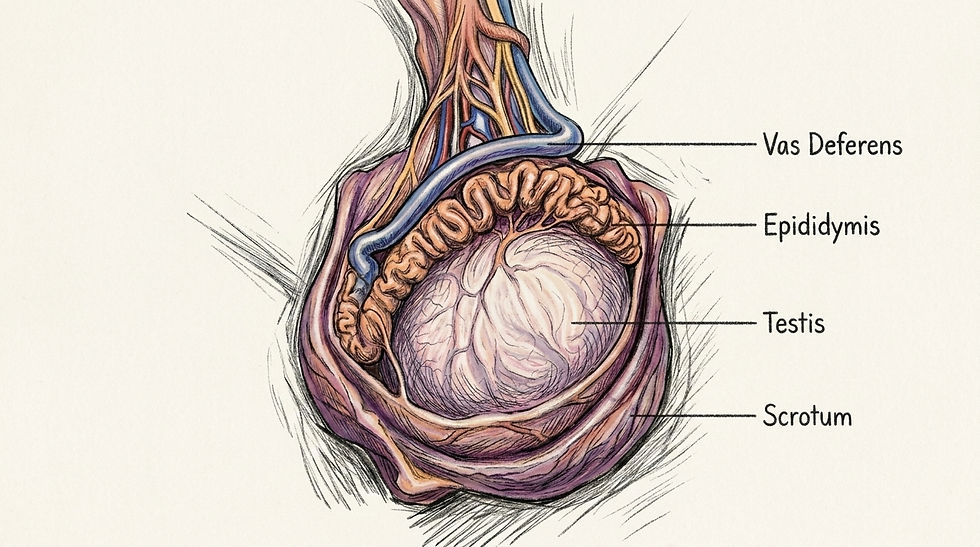
Testosterone is responsible for the development and maintenance of male reproductive organs, including the epididymis, vas deferens, seminal vesicles, prostate gland, and urethra. It also promotes spermatogenesis (sperm production), development of male secondary sexual characteristics such as facial hair, axillary hair, deep voice, increased muscle mass, and influences male sexual drive (libido).
Ovary
The ovaries are a pair of female reproductive organs located in the pelvic cavity. They have two functions: produce ova (eggs) and secrete female sex hormones.

The two main hormones produced by the ovaries are Estrogen and Progesterone. Estrogen is secreted mainly by the developing ovarian follicles, while Progesterone is produced by the corpus luteum, which forms after ovulation.
Estrogen promotes the development of female reproductive organs, secondary sexual characteristics (such as breast development and a higher-pitched voice), and regulates the menstrual cycle.
Progesterone prepares the uterus for implantation, maintains pregnancy, and stimulates the development of mammary gland alveoli for milk production.


Comments